Believing that consuming unhealthy food reduces the lifespan of humans and endangers their well-being, the writer, a member of the medical profession, concludes that meat itself is the culprit. Relying on insufficient knowledge and inaccurate facts the writer was nevertheless searching.
He ingeniously describes the workings of the human body as if it were an engine because the car was the latest craze of the new century. His prediction that, one day, there would be doctors for the healthy, is rather astonishing.
The humourous illustrations for the vegetarians are by Benjamin Rabier and the ones for the meat-eaters by Lucien Métivet. I couldn’t decipher the signature in the pie chart of the world vegetarian population as it was believed to be at the time.
So here are a few pointers on longevity from an illustrated 1907 article. Keep in mind that what we think we know today about nutrients and their contribution to a healthly life was most likely a mystery at the time.
Aging is the wearing of a machine that needs good materials to function properly.
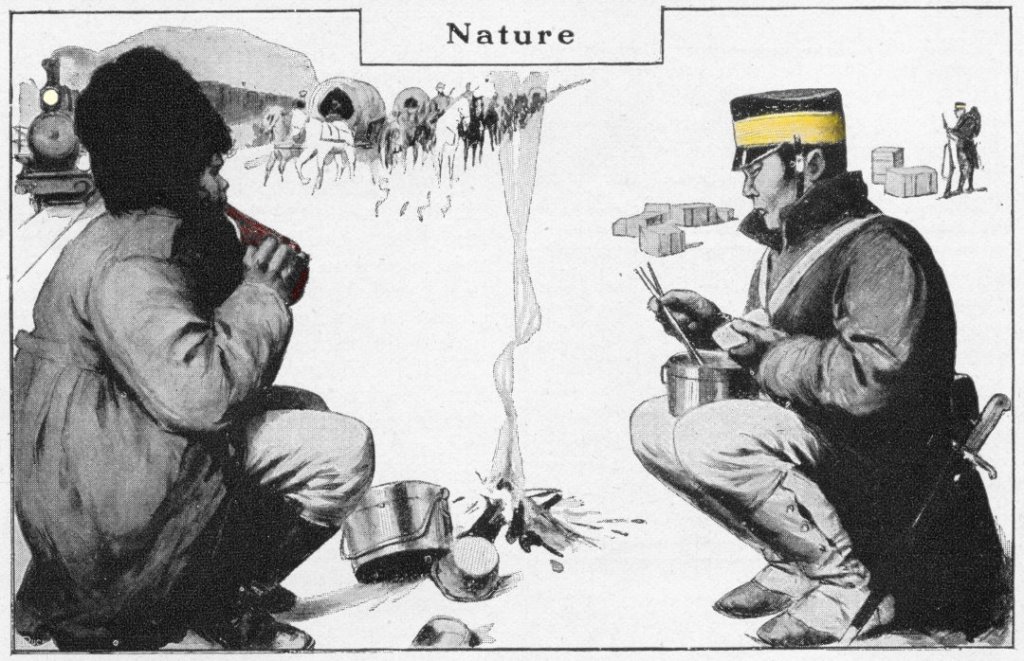
The natural process of aging was considered, in 1907 Europe, to be a disease that could be slowed down by eating vegetables. The recent Russo-Japanese war as in fact, the writer points out, a war between vegetable-eaters and meat-eaters.
- Vigor and endurance. It became obvious as the war wore on that the small Japanese soldiers were not lacking in vigor and endurance.
- Logistics. Provisioning the Russian army in food required entire trains whereas a few cases of rice were sufficient to the Japanese.
Shorten lifespan through poisoning. Humans’ lifespan is so short because by the time they reach maturity they suffer from an infectious chronic disease. A slow and mysterious poisoning flowing from a poison factory located in the last portion of the digestive tube, where legions of microbes live amongst the waste of digestion.
Microbial infection not natural. It was thought that this microbial infection was not a natural part of digestion since microbes are fewer in number in the upper portion of the digestive system. A certain Dr. Metchnikoff had proven that birds live much longer than mammals because they lack a large intestine.
In the dark as to the purpose of intestinal flora, the writer reassured his readers by stating that there was no need for the removal of about two meters of bowels in order to live longer.
Humans can, up to a point, “cure” themselves of aging by avoiding certain foods that pour alarming chemical poisons into the system. Those who had studied the human machine had understood its needs: fuel for maintenance, and grease for smooth performance.
The grease. In humans the equivalent of the engine grease is done by absorbing water and ingesting certain salts that are found in all diets: iron, lime, and salt (the latter added to cooking).
The fuel. Regardless of its form—whether animal or fish, legumes or fresh vegetables, dairy or eggs, fruits or pastries—fuel boils down to three food residus: albumin, sugar, and fat.Their name may change: fat may be called “oil”; sugar, “flour” or “starch”; and albumin, “gluten”. Regardless of their name, all three are sources of life by generating heat and energy, but the mecanics of production as well as the value of each differ.
- Albumin burns like alcool; it’s a flash in the pan that burns as quickly as it dies.
- Fat resembles coal that requires perfect draugt and careful fanning so that it doesn’t stop burning.
- Sugar has the advantages of both albumin and fat without their inconvinience. It consumes itself slowly and distributes its energy for hours: fatigue and exhaustion can be delayed by the use of sugar.
How was aging to be slowed down?
Avoiding gluten-rich meats. The write deducts from the above that meat that is rich in albumin must be avoided. Its consumption quickly warms the system giving the illustion of energy, but when its course stops it leaves a sudden feeling of depression and exhaustion.
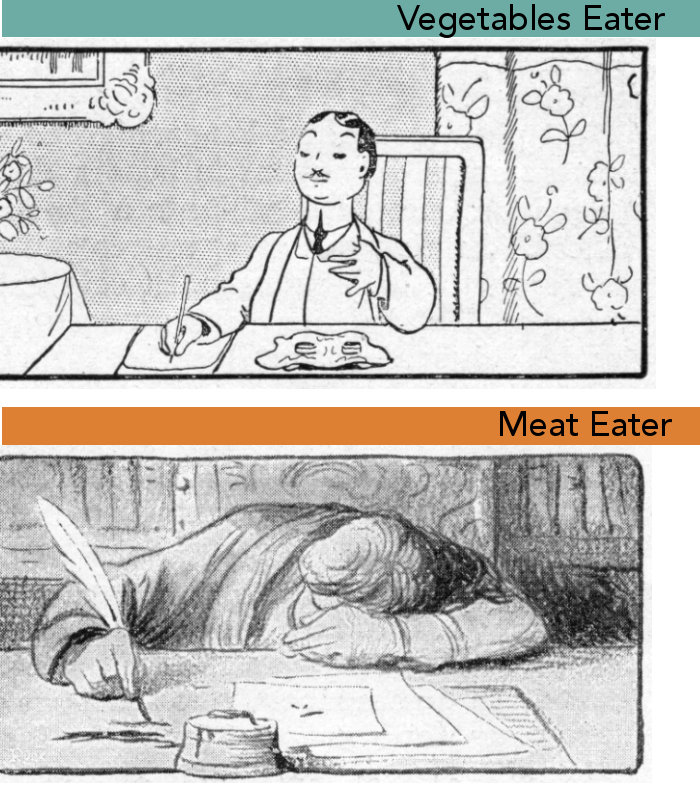
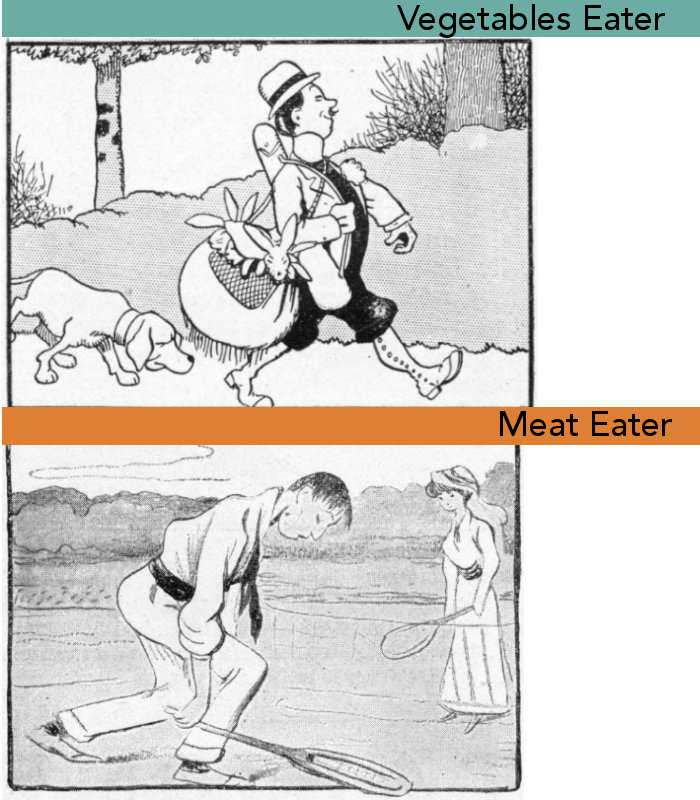
Carnivores feel the need to stimulate their energy by consuming alcool, tea, coffe; more poisons that are added to gluten. And the best proof is that the English, who are great meat-eaters, are also the greatest drinkers of tea.
Sugar was to be preferred. A common long-standing saying that “you must eat muscles to make muscles” was considered incorrect. In 1907, the medical profession believed that meat could be removed from the diet because sugar is the real fuel for muscles.
Gluten damages the organs. While sugar leaves a residu of water and carbolic acid in the body —harmless seltz water— gluten leaves a trail of fearsome corpuscules throughout the organs.
Mysterious poisons left by meats. The waste from consuming gluten-rich meats deposits poisons in the large intestin that are far more damaging than any form of sugar consumed by humans. Meat leaves mysterious poisons that slowly invade the organs, ruin the health of humans and steal years from their lifespan.

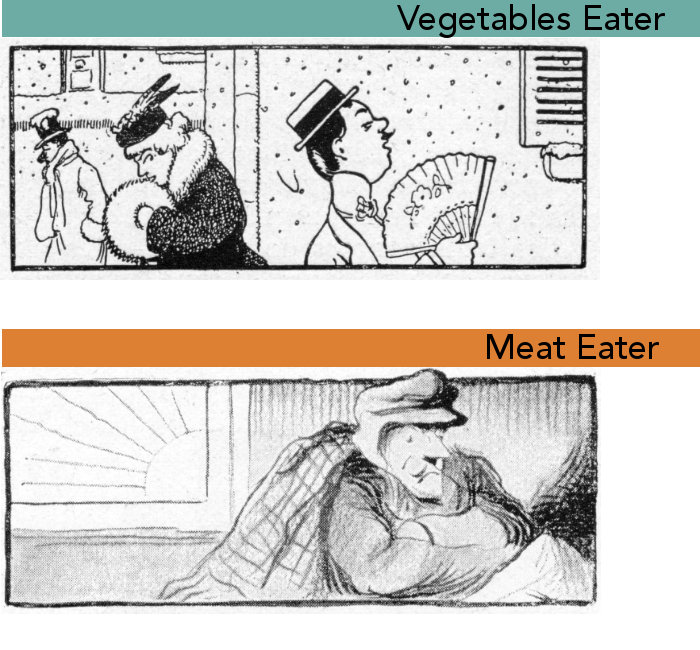
Meat was the aging party, was considered to be the source of “bad” gluten, and was to be eliminated from the human diet.
Almost every product of botanical origin contains gluten, but a type of gluten that doesn’t produce poisons. The very nature of plants removes them from the nefarious action of the microbes associated to putrefaction in the bowels.
The only diet that guaranteed the normal functionning of the human body was vegetarian. The taste for meat is not an instinct, it’s a fancy; in the same manner as humans have a taste for tobacco, alcool or coffee.
Theory backed by sciencists of the period. The illustrious Cuvier (George), the creator of comparative anatomy proclaims that humans are made for a diet that is primarily vegetarian. The naturalist Milne-Edwards reached the same conclusion by studying human teeth.
The ideal diet included:
- Milk and by-products (butter, cheese, eggs)
- Bread, grains, and sugar
- Potatoes
- Fresh vegetables & salads
- Fresh & dried fruits
To be excluded because of their poison-producing capacity:
- Legumes (dried beans, lentils, peas) they contain uric acid like meat.
- Cacao, asparagus, mushrooms, tea and coffee

The large number of vegeterians on earth was the proof of that diet’s success.
Some people had eliminated meat from their diets and some had proven their vitality by demonstrating that their diet could speak for itself. Chinese, Japanese, most of the Islamic people from the Balochistan region, the Mozambic, the Sahara, and Burma were vegetarians or near-vegetarians.
The writer estimated that the vegetarian population on earth was around 200 millions, compared to the meat-eaters who made up about 40 millions.
Notice that there are entire continents missing from the list above (as well as from the pie chart below) and that the argument is presented from a given European-centric view of the world in the 1900s. It may also simply be that the ethnic groups that are listed in the article were the ones that were most familiar to the average middle-class European of that time.
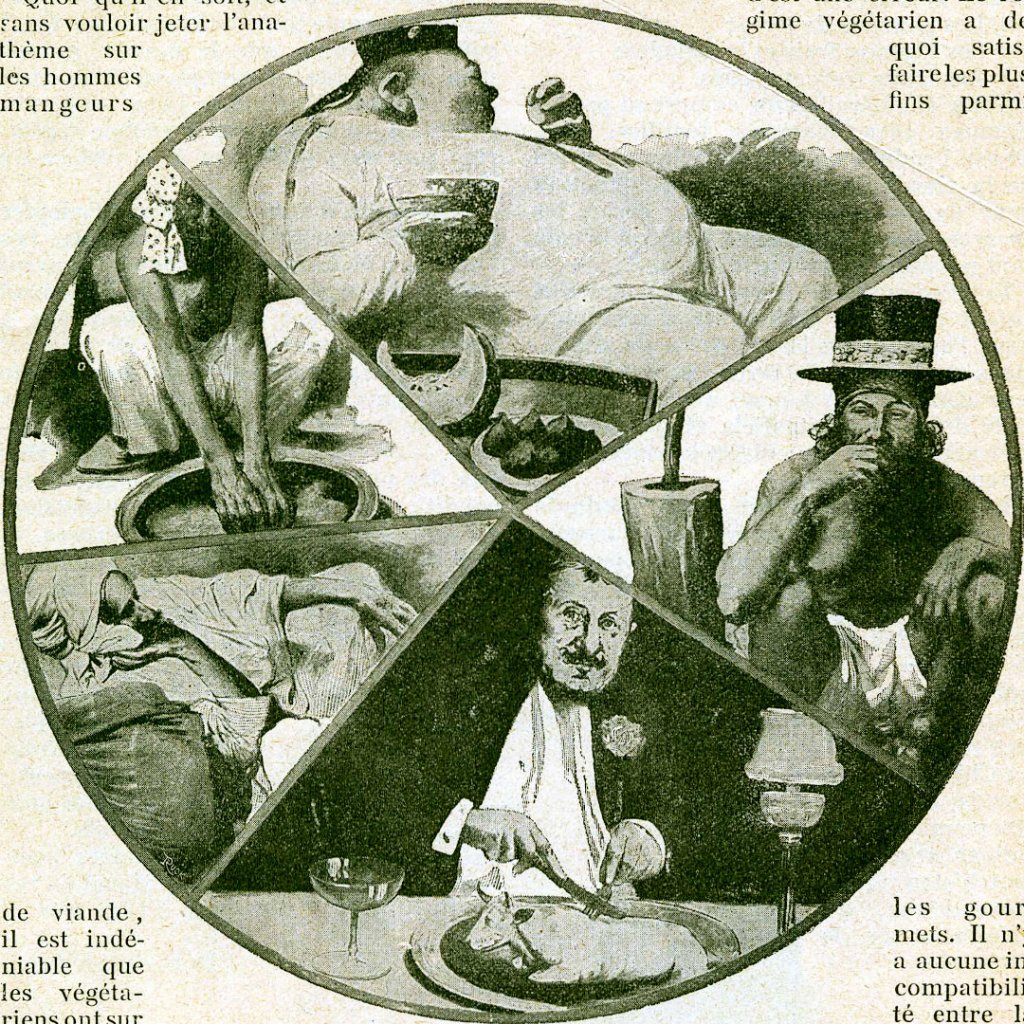
Pie-chart representing the proportion of vegetarians vs. meat-eaters on earth in 1907.
A day will come when there will be doctors for the healthy
The writer ends the article by stating his belief that, over time –and alongside the numerous specialists who were concentrating on ever smaller and targeted areas of the human body– there would come a day when there would be doctors called “doctors for healthy people”.
 Sewing Vintage & Illustrated Stories